Showing posts with label lecture. Show all posts

Monday, 23 November 2015

Scale - Small

Robert Crumb's "Short History of America" - 1979
Scale can be shown on a small scale in many different ways, Time can be difference scales but our everyday small time scales can be setting our alarms in the mornings, checking out phones through the day or measuring the time it takes to prepare or cook our food. But how do we show the passing of time through art?

Robert Crumb's comic panels focus on a view of a patch of land, each panel having either a major or minor change, based around what could of happened with in what time frames he's wanted to show us. Many of his pieces have one large jump in showing time were a road or path my pop up, followed by smaller changes like lampposts or gas stations; and yet that is a small enough feature to show a rough time setting for just one panel.

Another example was Martin Creed's short film/music video "Thinking// Not Thinking" in which 2 dogs, one small and one medium walk back and forth, sometimes overlapping sometimes alone in different directions but always ending from one side of the screen to another. The small dog in this piece was to represent thinking, how it can be quicker to pass everything around it. However in this case, it also showed how scale can change through out, in moments the smaller dog is closer to the screen than the bigger dog, making the small dog, bigger and changing its state and scale. (You could also take it further and if you were to ad another animal next to the larger dog, the large dog would then become the small/medium animal in the piece.)
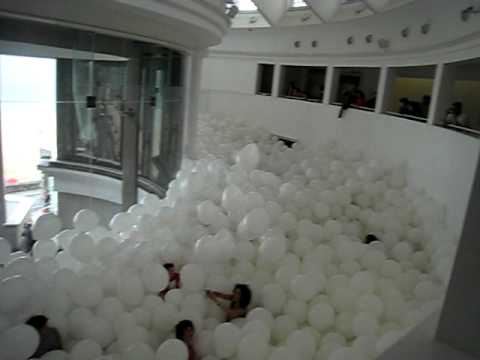

Other examples of scale within art we was shown was things like scale with in a space using balloon's as 'sculpture' that takes on the shape of the room, the small scale balloon's them self become a large scale piece by taking the shape. This can mess with a persons emotions and vision when viewed from within, scary? Weird? Disorientating? Fun?

Chris Ware's Building Stories also explores people within scale, the stories of many people living within a apartment complex, The largest drawing in this series happens to be the smallest character; a baby. (Related note - The Walled City 'Kowloon', houses built and built up again)


                                           ~ ~ ~ ~ ~ ~ ~ ~ ~ ~ ~ ~ ~ ~ ~ ~ ~ ~ ~ ~ ~ ~ ~ ~


Pop culture can use scale for comedy, most noted through the famous Father Ted joke of "small or far away", Showing a small toy of a Cow vs the cow's in a near by field that just happen to look small because of where we are. This also happens to us in everyday life, all around us and often running in the background.

We also looked at the music video from Talking Head's Psycho Killer, in which was rather strange with messing with scale. It starts with the lead singer on a large stage, making him appear small in context but as the song carries on you hear a audience that seems to a large one at that, making you envision that the stage is in a larger area than we think, which in turn then makes the singer smaller again. The set behind him also is being built as the song goes on, which makes it strange as the stage is literally growing around the singer. Many of Talking Head's music videos play with the idea of scale, either them travelling in places (small or large) or a smaller scale thing again such as wearing oversized shirts or jackets.

Scale in terms of production value could be used as another example with two different versions of "Much Ado About Nothing". Joss Weden made a modern day version with actors he had worked with previously, asking them to take part for a favor and filmed entirely in his mansion within 12 days. Then we can look at a large budge movie, like the 1993 version which had many actors, customs and actors. The scale had be changed completely through almost every way possible, The location, The budget etc.

Some other things that were look at -
Venice Carnival - Anyone can be anyone for the day by wearing a mask
Cosplay - A modern-ish version (becoming someone different for the day through outfits)
Powers of Ten (1977)
Zoom out from the earth - Couple having a picnic seems medium/small scale untill you zoom out and see the town, city, nation, Earth, universe - Quick scale change until all people are small.

"The scale of the universe shows how quickly it changes"
       

                                                          Ways of Measuring Scale 


    Ladder of  Scale :

   Global
   National
   Regional
   Urban
   Body/Person

   Small - Page
   Medium - Stage
   Large - Region
   X Large - Nation/World


A Brief look at the Fibonacci sequence : 


The Fibonacci sequence or the Golden Spiral is the idea that everything fits in a pleasing way to the eye, within this geological spiral.

Almost everything seems to fit this sequence; Nature, Art and photography. Many artists use this when either painting or setting up a photograph to make sure the final outcome has a naturally pleasing composition. 


Sunday, 12 April 2015

Reading the Spatial - Approaches to What

The lecture part of this task was a really interesting look at spacing and what space is, how it can be used and how important it can be.

A good example of spacing used in art was the 1533 Painting "The Ambassadors" by Hans Holbein. The painting as been the subject of many debates due to the items involved in the work. Aside from the spacing of the two characters involved, the most eye catching piece of the painting has to be the 'squashed' skull in the middle bottom of the piece. The spacing factor of the skull isn't the way it is placed in the painting, But how you are placed when you view it. From the photograph the skull has the stretched look to it, But if you were to move the skull becomes in focus. The major debate of this piece is the idea that it pictures everything to do with wealth: Globes, nice clothes, books. However the hidden skull seems to be a underlying message of no matter how different life is for some, how rich or how poor, we all face death and that it's always there wherever we may be ourselves. 


The next part of the lecture was looking at the 'Spatial'. What is Spatial? What is space?

The Spatial is the relating to or involving of having the nature of space existing or happening in space. Space on the other hand is distance between points, objects or events. 

It was really insightful to think of the spacing of art through thing like comic panels, how the spaces between other panels, speech bubbles and placing of the characters can change the over all mood and tone of the story or moment. 

                              ~ ~ ~ ~ ~ ~ ~ ~ ~ ~ ~ ~ ~ ~ ~ ~ ~ ~ ~ ~ ~ ~ ~ ~ ~ ~ ~ ~ ~ ~ ~ ~ 

TASK :
Approaches to What?
Create a sketch/drawing/comic page based on your interpretation of Georges Perec's 'Approaches to What'


These were sketches alongside quotes from the extract of Approaches to What. I wanted to focus on doing sketches rather than a full drawing, as there were so many different quotes that gave me funny little ideas. I think my favourite ones are the "Question your spoons" just because I had an image of a guy staring at cutlery confused or someone surrounded by floating spoons as well as the one about "Our lives in a dreamless sleep" as it made me think of the movie Inception and to do some kind of panel thing with thought bubbles within thought bubbles. 

                  (The images can be enlarged by clicking on them to read my notes/ideas) 

References :

http://dictionary.reference.com/browse/spatial

http://dictionary.reference.com/browse/space

Wednesday, 8 April 2015

Reading the Temporal - Time and Art

Robert Crumb - "A Short History of America"
The lecture of Reading the Temporal started with asking firstly, what is 'temporal'? I had to admit, I hadn't really heard this word outside of a medical term such as the temporal parts of the brain, so looking up the definition was interesting to find out, how this word can be applied to different things. Temporal is to be related to time, lasting a short period of time or alternatively 'temporary'.

Looking at the comics of Robert Crumb was a good example of time shown in an art form, his series of 'A Short History of America' shows areas in different time periods, showing how a landscape can change with time, things being constantly removed, replaced or  built up. 


Comic's are probably the best example of how time can be seen in art, as multiple panels, pages or volumes allow the artist to show change based around a story and the progression of characters and where they are. Naturally, using the aging of characters are a easy way of showing the progression of time. 


The best example I can think of with this is the character of Carl Grimes from The Walking Dead comics. 


(The Walking Dead) Carl Grimes aging progression - 7 - 13/14 years old
Tony Moore (1st Panel) / Charlie Adlard (2nd and 3rd panel)

Christian Marclay's 'The Clock' stills
When thinking of Time used in film, most of us thought of Christian Marclay's 24 hour long film "The Clock", made up entirely from movie and TV show clips where any device showing the time is put into a day long compilation. 

It's quite an amazing idea that this film can last 24 showing the exact time of day while it's being watched (Example -  if the movie shows a clock with 3:00pm on it, If the film was started at mid day, then the correct time would also be 3:00pm real time) 


La Jetee Poster

The other film that we were shown was a short by Chris Marker called 'La Jetee'. It was really bizarre and from the notes I took at the time the film followed a man captured and used for scientific experiences in the aftermath of a fictional World War Three bombing in France. 

The man was being used to tap into his memories and past in hope that he could also tap into the future in further experiments. The use of time in this film was more Science Fiction themed, Involving time travel. The main conclusion is only seen at the very end of the film, where the man's first memory of a man being shot was actually his own death.  

Rather than a traditional movie, La Jetee is made from photographs to create a sense of movement and time flow. I think the use of the photograph slideshow style is really effective in creating a dramatic mood to fit the theme of the story. It's also not something many people will be used to seeing, so it becomes instantly quite eye catching for many people. 

"Glued to an image of his past, If we can handle the past then we can live in the future"


                                        ~ ~ ~ ~ ~ ~ ~ ~ ~ ~ ~ ~ ~ ~ ~ ~ ~ ~ ~ ~ ~ ~ ~ ~ ~ ~ ~ ~ ~ ~ ~ ~ ~ ~ 


Looking at other uses of time in art? 

Random thought when thinking of ways to show a passing of time was from The Walking Dead TV show, the shot-for-shot pan up on the city of Atlanta from Season 1 and shown again half way through season 5. (I do apologise for the heavy use of Walking Dead references in this post) 


The Walking Dead season 1 and season 5 screen caps / Episodes - Days Gone Bye // Consumed (c) AMC


Screencap from The Clock Puzzle in Silent Hill Downpour (c) Konami


Another quick thought I had was the use of clocks in the design and puzzles of the video game Silent Hill Downpour, that are used throughout the game as a reference to the main character's time being constantly pushed or always missed through his story, such as time he wasted in prison, how he was too late to save his son from being murdered, the time spent planning how to be imprisoned to get revenge on his son's murderer, etc. 


When thinking of other uses of time in art, I was kind of stumped for things I could think of asides from movies or TV shows that feature time travel or have heavy emphasis on timekeeping i.e Lost, The Time Travelers Wife, Doctor Who. So I wanted to get the description of the word 'Temporal' (As shown at the start of this post)  

What is temporal art?
Art that ceases to exist, examples  - Performance Art, Ice Sculptures, etc

Seen as a new and modern art movement that is still to really be widely recognized, many of us would have seen or experienced some form of temporal art in our life, Street performers using chalk on pavements, watching plays at the theater or watching a fireworks display. The fun of temporal art is that it encourages people to experience these things first hand, 

however the major downfall of the movement, is many people would share the art as photos or recordings online rather than first hand. 
Don Chapelle working on an ice sculpture

It's still a cool way to spread a piece of art that can't be replicated or seen at the time, but it does take away some of the magic if people prefer to view such pieces through screens. Some of my favourite examples of temporal art are the works of Don Chapelle. 

He makes his ice sculptures using a chainsaw to create both fine and simple details. Naturally, due to the nature of ice, his works are only able to viewed in the flesh on display for about a day depending on where his work is being displayed and stored.


Andy Goldsworthy's piece "Cairn" from 1997,
made and displaced in Herring Island, Australia 


The works of Andy Goldsworthy are fairly similar also. I came across his work while googling Temporal Art. He works with any kind of natural materials, such as stones, leaves and feathers that he displays is patterns in the wilderness of woods and such. Some of his works may last much longer than others, for instances feathers in a pond will only likely last in place moments where as twigs weaved together have a chance to last for a fair while. His work is something truly unique and I can't think of anyone who uses nature or art in such a way. 

I really struggled to find artists who fit into a temporal movement, and illustration/illustrators don't really seem to be the people found within the movement itself. Time can be found in many different subjects, mostly in film and television and the art work seems to be working it's way to incorporate more time-based works in the modern day. 


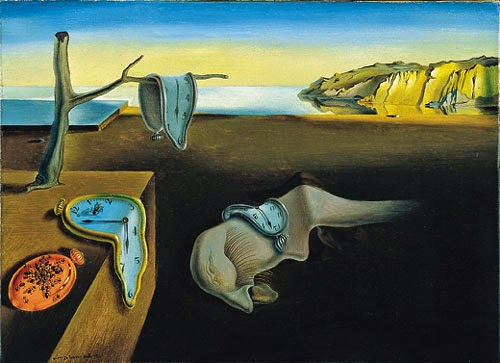
Salvador Dali - The Persistence of Memory
A classic example of a form of temporal art, could be Salvador Dali's 'The Persistence of Memory'. Seen as probably his most famous work, the dripping clock imagery is familiar to everyone, but yet it's still quite a mystery as to what Dali's meanings behind it could be.

Most would agree that the clock's in this piece would be about reminding us about death, the inevitability of time ending. The 'figure' in the bottom center of the painting could be also been seen as a dead creature, making the idea much more solid. However, I think the air of mystery surrounding this piece is a great addition in itself, making it a timeless image that people will be talking about for many years to come. 


Piece from 'Annabelle's Illustration' depicting fashion
from 1900 to 2000
Fashion is also another way of looking at time. Although this is another form of reading time that may not be completely illustration based, There are many ways to depict fashion. It can be seen through TV and movies but also through fashion clothing itself or fashion illustration all based on era's, What was popular at the time can be widely pinpointed to a decade or era, such as when most people think of neon colours in clothes we think of the 1980's. 


                                ~ ~ ~ ~ ~ ~ ~ ~ ~ ~ ~ ~ ~ ~ ~ ~ ~ ~ ~ ~ ~ ~ ~ ~ ~ ~ ~ ~ ~ ~ ~ ~

References : 

http://artstalks.tumblr.com/post/25038332771

http://www.brillianticesculpture.com/about.html Don Chapelle's website

http://dictionary.reference.com/browse/temporal 

http://www.moma.org/learn/moma_learning/1168-2

My own knowledge of Silent Hill/The Walking Dead 

http://totallyhistory.com/the-persistence-of-memory/


Bonus ref (?) / Theorist?


(Book preview) All though this book preview really isn’t about art and time, but the art of the passing of time, it was interesting to think about how time can effect things just by passing. It made me think of previous lessons where we’ve looked at renaissance art, thinking about how at the time science was the focus of peoples minds rather than religion, which affected the subject matters of the paintings.  Movements still appear to this day based around a societal way of thinking, such as the rise of graffiti as a ‘style’ or ‘movement’ to go with modern day rebellion and thought of an oppression many feel from governments. The ‘pop art’ movement that appeared shortly after World War II to give new life and fun to people using bright colours and popular images or things at the time to bring the country together.  

Monday, 27 October 2014

Las Meninas - Lecture and Evaluation

100 Words on 'Las Meninas' By Diego Velazquez


Las Meninas is a truly interesting piece of traditional art. At first it looks fairly plain, Like any other old style painting, But when you start to look in more detail, that's when you find the real fun this piece has to offer. The illusion of painting yourself painting seems like a modern day quirk yet it's something used here that at first is not east to see. I really like the almost puzzle solving-like mysteries this piece has, as it really separates it from any other painting from that time. It really shows the creativeness Diego Velazquez had.  

Wednesday, 22 October 2014

Reading the Map - Lecture overview and outcome

14/10/2014

Today we had a lecture about maps and mapping. We started off by looking at how differently the world map has changed since the 18th Century and how an aged map may not be as trustworthy as we think. It was interesting to look at just how different things can be from just a short period of time or just what someone else would picture and choose to create.
"Asia as Pegasus"


Another map we looked as was the famous London Tube Map. Even though it may be one of the most recognizable maps in Britain, It is actually quite different to a realistic rendition.

Other maps we looked at included a very unique map called "Asia as Pegasus" from 1590. The map of Asia was drawn to look just like that of a Pegasus (Winged Horse) and would be used to easily navigate by using parts of the horse to describe your journey - "I.E- Travel along the horses tail until you reach the flank, then you should be at Tokyo"

An even more interesting way to look at mapping and maps were the music videos and TV intros we watched, The music video by 'Cake' called 'Short Skirt Long Jacket' was at first glance a car driving with text messages along the screen, But it began to raise more questions as you watched, What do the text messages say? Where is the car going? The view from the car changed at one point, Why?

And finally we looked at the Game of Thrones opening title, The map of the fictional world was like a 3D Pop-up book as it moved around, Showing new and different locations, Interestingly enough, usually showing an actors name over a town where their character maybe in the episode. The visuals are totally different to most TV show openings, which is what makes it such a memorable opening as well as one that's fun to look at each time. 


Game of Thrones Screencap showing an aerial view of the country and it's name "Westeros"  

This then reminded me of the 'Walking Dead' opening, which follows a similar theme. Each series the images change to where the characters maybe more mentally and physically - I.E - Main character Rick Grimes's Sheriff's badge lies on the ground for season 2 (Along side the actors name, Andrew Lincoln), Symbolizing his change of 'doing what's lawful or right' to 'doing what we must to survive' or the slow pan of a prison, in which plays a big role in series 3/4. Other images may not be clear at first but as the series continues they seem more relatable to key moments - i.e Other buildings, bloodied weapons, strange out of place items. 

The Walking Dead screencaps from the opening sequence. Top middle example showing Rick's Sheriff badge.
 ~ ~ ~ ~ ~ ~ ~ ~ ~ ~ ~ ~ ~ ~ ~ ~ ~ ~ ~ ~ ~ ~ ~ ~

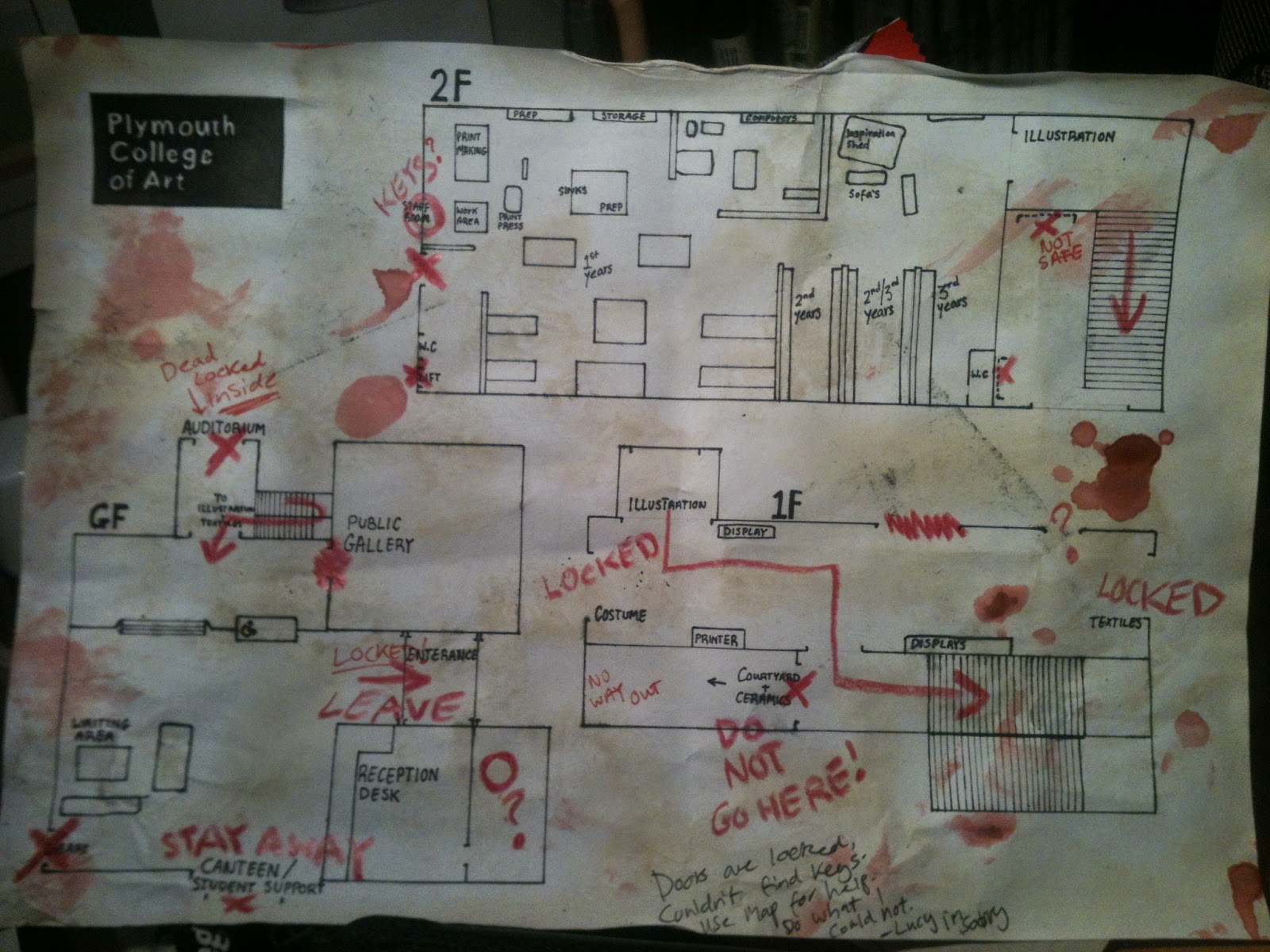
The project we had to take away with us was the create our own map of the college. We could choose to do any area of the college in any style/layout we wished, just no bigger than A4. 

Doing a short film mapping out my journey to college in this style crossed my mind, However I knew I wouldn't have the time/equipment to do this within a week. I instead looked at some of my favourite video games for inspiration. The world map of fictional Tamriel of the Elder Scrolls series crossed my mind as I like the way each region is in a different colour. But I then started to look at Silent Hill for inspiration, It's simple and realistic indoors style with markings to show locked doors/items seemed like a fun idea, So overall I picked a Silent Hill/Horror Survival Theme. (It is almost Halloween after all!)


(Temriel World Map - The Elder Scrolls, Brookhaven Hospital Map - Silent Hill 2, Map of Albion - Fable)


Our finished map is due to be shown: 21/10/2014My Finished Map Project ~