Showing posts with label research. Show all posts
Showing posts with label research. Show all posts
Thursday, 9 April 2015

Wednesday, 8 April 2015
Reading the Temporal - Time and Art
 |
| Robert Crumb - "A Short History of America" |
Looking at the comics of Robert Crumb was a good example of time shown in an art form, his series of 'A Short History of America' shows areas in different time periods, showing how a landscape can change with time, things being constantly removed, replaced or built up.
Comic's are probably the best example of how time can be seen in art, as multiple panels, pages or volumes allow the artist to show change based around a story and the progression of characters and where they are. Naturally, using the aging of characters are a easy way of showing the progression of time.
The best example I can think of with this is the character of Carl Grimes from The Walking Dead comics.
 |
| (The Walking Dead) Carl Grimes aging progression - 7 - 13/14 years old Tony Moore (1st Panel) / Charlie Adlard (2nd and 3rd panel) |
 |
| Christian Marclay's 'The Clock' stills |
It's quite an amazing idea that this film can last 24 showing the exact time of day while it's being watched (Example - if the movie shows a clock with 3:00pm on it, If the film was started at mid day, then the correct time would also be 3:00pm real time)
 |
| La Jetee Poster |
The other film that we were shown was a short by Chris Marker called 'La Jetee'. It was really bizarre and from the notes I took at the time the film followed a man captured and used for scientific experiences in the aftermath of a fictional World War Three bombing in France.
The man was being used to tap into his memories and past in hope that he could also tap into the future in further experiments. The use of time in this film was more Science Fiction themed, Involving time travel. The main conclusion is only seen at the very end of the film, where the man's first memory of a man being shot was actually his own death.
Rather than a traditional movie, La Jetee is made from photographs to create a sense of movement and time flow. I think the use of the photograph slideshow style is really effective in creating a dramatic mood to fit the theme of the story. It's also not something many people will be used to seeing, so it becomes instantly quite eye catching for many people.
"Glued to an image of his past, If we can handle the past then we can live in the future"
~ ~ ~ ~ ~ ~ ~ ~ ~ ~ ~ ~ ~ ~ ~ ~ ~ ~ ~ ~ ~ ~ ~ ~ ~ ~ ~ ~ ~ ~ ~ ~ ~ ~
Looking at other uses of time in art?
Random thought when thinking of ways to show a passing of time was from The Walking Dead TV show, the shot-for-shot pan up on the city of Atlanta from Season 1 and shown again half way through season 5. (I do apologise for the heavy use of Walking Dead references in this post)
 |
| The Walking Dead season 1 and season 5 screen caps / Episodes - Days Gone Bye // Consumed (c) AMC |
 |
| Screencap from The Clock Puzzle in Silent Hill Downpour (c) Konami |
Another quick thought I had was the use of clocks in the design and puzzles of the video game Silent Hill Downpour, that are used throughout the game as a reference to the main character's time being constantly pushed or always missed through his story, such as time he wasted in prison, how he was too late to save his son from being murdered, the time spent planning how to be imprisoned to get revenge on his son's murderer, etc.
When thinking of other uses of time in art, I was kind of stumped for things I could think of asides from movies or TV shows that feature time travel or have heavy emphasis on timekeeping i.e Lost, The Time Travelers Wife, Doctor Who. So I wanted to get the description of the word 'Temporal' (As shown at the start of this post)
What is temporal art?
Art that ceases to exist, examples - Performance Art, Ice Sculptures, etc
Seen as a new and modern art movement that is still to really be widely recognized, many of us would have seen or experienced some form of temporal art in our life, Street performers using chalk on pavements, watching plays at the theater or watching a fireworks display. The fun of temporal art is that it encourages people to experience these things first hand,
however the major downfall of the movement, is many people would share the art as photos or recordings online rather than first hand.
 |
| Don Chapelle working on an ice sculpture |
It's still a cool way to spread a piece of art that can't be replicated or seen at the time, but it does take away some of the magic if people prefer to view such pieces through screens. Some of my favourite examples of temporal art are the works of Don Chapelle.
He makes his ice sculptures using a chainsaw to create both fine and simple details. Naturally, due to the nature of ice, his works are only able to viewed in the flesh on display for about a day depending on where his work is being displayed and stored.
 |
| Andy Goldsworthy's piece "Cairn" from 1997, made and displaced in Herring Island, Australia |
The works of Andy Goldsworthy are fairly similar also. I came across his work while googling Temporal Art. He works with any kind of natural materials, such as stones, leaves and feathers that he displays is patterns in the wilderness of woods and such. Some of his works may last much longer than others, for instances feathers in a pond will only likely last in place moments where as twigs weaved together have a chance to last for a fair while. His work is something truly unique and I can't think of anyone who uses nature or art in such a way.
I really struggled to find artists who fit into a temporal movement, and illustration/illustrators don't really seem to be the people found within the movement itself. Time can be found in many different subjects, mostly in film and television and the art work seems to be working it's way to incorporate more time-based works in the modern day.
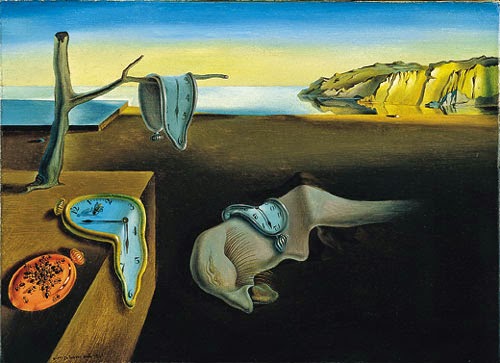 |
| Salvador Dali - The Persistence of Memory |
Most would agree that the clock's in this piece would be about reminding us about death, the inevitability of time ending. The 'figure' in the bottom center of the painting could be also been seen as a dead creature, making the idea much more solid. However, I think the air of mystery surrounding this piece is a great addition in itself, making it a timeless image that people will be talking about for many years to come.
 |
| Piece from 'Annabelle's Illustration' depicting fashion from 1900 to 2000 |
~ ~ ~ ~ ~ ~ ~ ~ ~ ~ ~ ~ ~ ~ ~ ~ ~ ~ ~ ~ ~ ~ ~ ~ ~ ~ ~ ~ ~ ~ ~ ~
References :
http://artstalks.tumblr.com/post/25038332771
http://www.brillianticesculpture.com/about.html Don Chapelle's website
http://dictionary.reference.com/browse/temporal
http://www.moma.org/learn/moma_learning/1168-2
My own knowledge of Silent Hill/The Walking Dead
http://totallyhistory.com/the-persistence-of-memory/
Bonus ref (?) / Theorist?
(Book preview) All though this book preview really isn’t about art and time, but the art of the passing of time, it was interesting to think about how time can effect things just by passing. It made me think of previous lessons where we’ve looked at renaissance art, thinking about how at the time science was the focus of peoples minds rather than religion, which affected the subject matters of the paintings. Movements still appear to this day based around a societal way of thinking, such as the rise of graffiti as a ‘style’ or ‘movement’ to go with modern day rebellion and thought of an oppression many feel from governments. The ‘pop art’ movement that appeared shortly after World War II to give new life and fun to people using bright colours and popular images or things at the time to bring the country together.
Friday, 21 November 2014
Group Presentation - Group D - Cubism
 At the end of last weeks Lecture, We were given a list of art movements alongside groups that our year group has been in since the start of this term. I am in Group D, Who were presented with the movement Cubism. The presentation should be no longer than 10 minutes and everyone in the group should contribute towards it, including an original piece in that style. Firstly I went to look up the origins of Cubism alongside some of the most famous Cubist artists as part of the research, However I knew we'd have to wait and see when we could get the group together so that we can make sure we all do something different to add to the presentation. Within a few days we had made sure to add each other on Facebook, as it has been the easiest way to be in contact with each other. (Left, Group chat on Facebook to plan a get together)

Here was the information I gathered before the meet up with the group on the 21st. -
Origins ~
 In fine art,
the term Cubism describes the revolutionary style of paint that was invented by
Pablo Picasso and Georges Braque while they were in Paris during 1907-1912. The
Cubist movement is largely influenced by geometric patterns and shapes and is
often seen as a type of abstract or Realism art. Many believe Picasso’s Les
Demoiselles d'Avignon (The Young Ladies of Avignon - 1907) and Braque’s L'Estaque
(1908) to be the first real Cubist pieces. The Cubism movement continued to
grow and had many other artists become labelled as ‘Cubists’ such as Marcel
Duchamp, Salvador Dali and Francis Bacon.
There are a listed four periods of Cubism:
* Early Cubism or Cézannisme (1908-1910)
* Analytic Cubism (1910-12) - Characterised by multiply viewpoints of an object that overlap
* Synthetic Cubism (1912-14) - Characterized by an overall flatter and more geometrically simplified style.
* Early Cubism or Cézannisme (1908-1910)
* Analytic Cubism (1910-12) - Characterised by multiply viewpoints of an object that overlap
* Synthetic Cubism (1912-14) - Characterized by an overall flatter and more geometrically simplified style.
* Late Cubism (1914 - Present)
Cubism can
also been seen as a movement that started the trend of modern art movements,
Inspiring others such as Futurism (1909-1914) and Dada (1916-1924).
Guernica – Pablo Picasso
Nude Descending a Staircase, No.2 – Marcel Duchamp
The Weeping Woman – Pablo Picasso
Glass of Beer and Playing Cards – Juan Gris
Violin and Candlestick – George Braque
~ ~ ~ ~ ~ ~ ~ ~ ~ ~ ~ ~ ~ ~ ~ ~ ~ ~ ~ ~ ~ ~ ~ ~ ~ ~ ~ ~ ~ ~ ~ ~ ~ ~ ~ ~
Most the the group could make it to the meet up that we planned (21st November, 11PM) where we talked about what people had already done or would prefer to do. We all settled with an idea in mind and where given roles to research each. I chose to research one of the prominent Artists, George Braque. We also decided to research a total of 3 artists, roughly about 100 words per artist, as to keep the information informative and clear, plus to keep in with the 10 minutes we have. We also choose to keep to a Powerpoint presentation and have 4 key sections, Intro - Context - Influences - Legacy. We will also continue to keep in touch through Facebook and e-mail to send through our work and research to each other.
This was my section of research on the artist Geroges Braque :
Georges
Braque ~ 1882 – 1963
 |
| Houses at L'Estague - 1908 |
Some of his most famous works include ‘Violin and Candlestick’ – 1910 and ‘Houses at L’Estague 1908’
~ ~ ~ ~ ~ ~ ~ ~ ~ ~ ~ ~ ~ ~ ~ ~ ~ ~ ~ ~ ~ ~ ~ ~ ~ ~ ~ ~ ~ ~ ~ ~ ~ ~ ~ ~ ~ ~ ~
Update 25/11/2014
Most of the group met up again to go over the presentation now that we had all gathered information over the weekend. We sat down around a computer and doubled checked that we did have all the information that we wanted, ready to then be finalized as a powerpoint for the presentation. Firstly we talked through the order of the slides and settled on a layout as such :
Intro - Types of Cubism - Context - Artists - Legacy - Our own works
We managed to get the bulk of the powerpoint done, asides from the final slides of the groups own works, because the paintings are still in progress. However, We were happy with the outcome and it shouldn't need many final touches. We then agreed to all make notes and/or flash cards so that when it will be our time to do the presentation, we will all have a section to talk about. We will also work out who says what slide when we meet again and have the completely final version.
Example of the presentation :


When the day came to present out work, some of our group were away, so we couldn't use the plan of one person per slide. In the end Nate in the group said he would be comfortable reading the slides while someone changed them as he spoke. I believe we did well in gathering all necessary information and presenting it in a clear way that was easy to understand. Our group worked well together and we did manage to get everything done on time.
The finished version of the powerpoint will be uploaded separately as a viewable powerpoint when compete.
EDIT -
Powerpoint has been uploaded an is viewable on the blog :)
Just search for posts related to BCOP100 for the entitled "Cubism Presentation - BCOP"
~ ~ ~ ~ ~ ~ ~ ~ ~ ~ ~ ~ ~ ~ ~ ~ ~ ~ ~ ~ ~ ~ ~ ~ ~ ~ ~ ~ ~ ~ ~ ~ ~ ~ ~ ~ ~ ~ ~ ~ ~
Sources used :
http://www.visual-arts-cork.com/history-of-art/cubism.htm
http://arthistory.about.com/od/modernarthistory/a/cubism_10one.htm
http://www.theartstory.org/artist-braque-georges.htm
http://www.tate.org.uk/art/artists/georges-braque-803
http://www.artchive.com/artchive/B/braque.html
Subscribe to:
Posts (Atom)